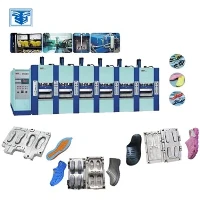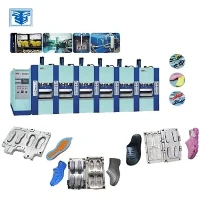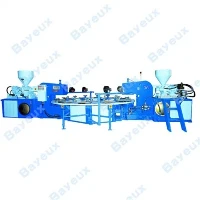


Quanzhou Bayeux Industrial Co., Ltd. is one of the leading manufacturers and suppliers of pvc/dip shoe machine in China. With a professional production team, we are able to meet the needs of the majority of our customers. Please rest assured to buy customized pvc/dip shoe machine from our factory.
This machine is a fully automated rotary continuous-side injection molding system specifically developed for mass production of PVC footwear. The equipment utilizes a continuous rotary turntable and precision direct-injection molding technology. Designed for efficient production of a wide range of footwear, including student shoes, labor Shoes, safety shoes, sports shoes, casual shoes, Comfort Shoes for Women, and leather shoes. The process is straightforward with one-step molding capability, only changing the mold and the shoe upper to products different styles and sizes of products. In the footwear industry, PVC Injection Molding Machine is a revolutionary footwear manufacturing solution that enables the shoe upper and sole to be molded into a single piece. This innovative technology completely transforms the traditional shoe manufacturing process, where the upper and sole are produced separately and then assembled through adhesive bonding or stitching.The basic principle of the integrated upper-and-sole injection molding process is as follows: the shoe upper is first formed on a shoe last. The shoe last with the completed upper is then placed into the sole injection molding machine, where it is securely fixed by the clamping system and precisely aligned with the sole mold. Molten material is injected into the mold and solidifies, permanently bonding the sole to the upper as a single integrated structure. The resulting footwear is environmentally friendly, free of stitching and adhesives, highly durable, and offers a lighter, more comfortable wearing experience.
What is the core working principle of this machine?
The shoe sole molding injection molding machine achieves integrated formation of the sole and upper through its precision mechanical structure and control system. Its operational process primarily consists of the following eight steps:
Raw Material Preparation
Before the injection molding process begins, synthetic rubber, PVC, TPU, TPR, or other injection-moldable materials suitable for footwear production are first loaded into the hopper in the form of plastic pellets. Different materials offer distinct physical properties. For example, ultra-lightweight PVC provides low weight, excellent hydrolysis resistance, and oil resistance, while TPU offers vibrant colors, outstanding abrasion resistance, and superior durability.
Melting and Plasticizing
The material enters the heated barrel of the injection molding machine through the hopper. Inside the barrel, it is continuously compressed, conveyed, and rotated by the screw or plunger, where it is heated and melted into a homogeneous molten material. During this process, the temperature must be precisely controlled to ensure the material reaches the optimal flow state without undergoing thermal degradation.
Shoe Mold and Uppers Positioning
This is one of the critical steps in the shoe uppers injection molding process. The shoe upper mold with its structure is secured to the equipment using a positioning assembly, ensuring no displacement during injection. Modern positioning mechanisms feature ingenious designs-such as quick locking or unlocking of the mold by simply operating a lever-significantly enhancing operational efficiency.
Mold Clamping
The sole mold typically consists of a base mold and left/right side molds. During the molding process:The two side molds move toward the shoe last positioned in the center, with the upper notches of the side molds pressing firmly against both sides of the shoe last.The two side molds are fitted together to form a complete mold cavity.The shoe last, the two side molds, and the bottom mold are assembled together to form a mold cavity for injection molding.At this point, a portion of the shoe upper is also enclosed within the mold cavity.
Injection Stage
Once the molten plastic reaches the appropriate temperature and viscosity, the injection unit of the molding machine injects it into the pre-designed mold cavity under high pressure. The mold contains the complete three-dimensional shape of the footwear, including the bonding area between the upper and the sole. Advanced equipment such as Desma adopts the Direct Injection Process (DIP), allowing the plasticized sole material to penetrate directly into the upper, thereby achieving optimal adhesion strength.
Filling and Holding Pressure
As the melt enters the mold cavity, it is rapidly filled under sustained pressure to ensure complete filling of the entire mold space, forming a continuous structure for both the upper and sole while eliminating internal bubbles or defects. The holding-stage process also compensates for volume reduction caused by material cooling shrinkage.
Cooling and Setting Stage
The molten plastic injected into the mold gradually cools and hardens, forming a unified structure for both the sole and upper of the shoe. Taking PU material as an example, the transition from liquid to solid state only takes a few seconds.
Demolding Stage
After the product is fully solidified, the mold opens, and the cooled and hardened shoe is usually removed from the mold by a robotic arm or other automated devices. Modern advanced equipment has achieved high production efficiency, with the ability to produce one shoe every 8 seconds.
What is the production capacity of PVC Injection Molding Machine?
We offer several machine models, including 12/16/20/24 stations, to meet the production requirements of factories of different scales. The 12-station model can produce approximately 125 pairs per hour, the 16-station model around 166 pairs per hour, the 20-station model around 200 pairs per hour, and the 24-station model up to 260 pairs per hour.Each station completes the molding cycle in sequence, allowing injection, cooling, and demolding processes to operate continuously without frequent machine stops. This rotary working principle improves equipment utilization, reduces production waiting time, and helps maintain stable daily output.
Actual production capacity may vary depending on shoe styles, product sizes, mold structures, cooling requirements, and operating conditions. With continuous production capability, flexible station options, and stable automatic operation, this PVC footwear molding machine is an ideal solution for medium-sized shoe factories, expanding manufacturers, and large-scale producers requiring reliable capacity for long-term PVC footwear production.
What are the specifications of PVC Injection Molding Machine?
| Item | Unit | 12 station | 16 station | 20 station | 24 station |
| Raw material | Tons | PVC/TPR | PVC/TPR | PVC/TPR | PVC/TPR |
| station number | Pcs | 12 | 16 | 20 | 24 |
| Mold Plate Size | mm | 210-260 | 210-260 | 210-260 | 210-260 |
| Mould height | mm | 260 | 260 | 260 | 260 |
| Mold-opening Stroke | mm | 210-260 | 210-260 | 210-260 | 210-260 |
| Injector | 1 | 1 | 1 | 1 | |
| Diameter of Screw | mm | 75 | 75 | 75 | 75 |
| Injection Cap(Max) | cm³ | 650 | 650 | 650 | 650 |
| Injection Pressure | kg/cm² | 120 | 120 | 120 | 120 |
| Electricity Consumption | Pairs/24 hours | 3000 | 4000 | 5000 | 6000 |
| Motor Power | kw | 19 | 23.5 | 23.5 | 23.5 |
| Total Electricity | kw | 29 | 33.5 | 33.5 | 33.5 |
| Machine Weight | kg | 8500 | 10000 | 11000 | 14000 |
| Machine Dimension | mm | 5000*2350*1950 | 6000*3150*1900 | 6300*3350*1950 | 6900*3900*1900 |
What are the main electrical component brands used?
| Item | Spec. | Import |
| Computer | FETAK | Taiwan |
| Screen | WEINVIEW | Taiwan |
| Telemecanique Contactor | DELIXI | Sino-foreign joint venture |
| Servo motor | EPSILON | China |
| Hydraulic Solenoid Valve | KCLKA | Taiwan |
| Oil pump | OULIDE | Sino-foreign joint venture |
| Oil pipe | RUISITE | Sino-foreign joint venture |
| Switch | KONEDA | China |
| Cylinder | JUNFAN | TaiWan |
Which materials does this PVC Injection Molding Machine support?
This equipment is suitable for a wide range of thermoplastic materials-including synthetic rubber, PVC, TPU, and TPR-and can produce both foamed and non-foamed footwear products. Most factories use PVC as the main sole material. By adjusting the formulation parameters of different materials, the machine can meet the production requirements of slippers, sandals, shoe soles, and other injection-molded footwear products, providing flexible material options for different product designs and market demands.
Which molds is this PVC Injection Molding Machine compatible with? How do I replace the mold?
This equipment is compatible with various PVC and TPR footwear molds. When producing products with different specifications or shapes, mold replacement is required. A standardized replacement process and proper precautions can improve mold change efficiency and ensure equipment safety.
01/
The first step of the replacement process is shutdown preparation: turn off the heating and cooling systems, and wait until the barrel temperature drops to a safe range. Then clean the residual plastic material inside the equipment to prevent the material from solidifying in the screw or barrel
02/
The second step is removal of the old mold. Operate the mold clamping system to open the mold, loosen the fixing bolts between the mold and the clamping frame, and slowly lift the old mold away from the clamping frame using the mold lifting device. Place the removed mold in the designated mold storage area
03/
The third step is installation of the new mold. Use the lifting device to align the new mold with the installation position on the clamping frame. Adjust the horizontal and vertical positions to ensure precise alignment between the mold and the positioning pins of the clamping frame. Then tighten the fixing bolts to securely fasten the mold onto the clamping frame
04/
The fourth step is commissioning and inspection. After installation, start the mold clamping system to test whether the mold opening and closing movements operate smoothly. Check whether the mold parting surfaces fit tightly. At the same time, connect the mold cooling water circuits and air passages to ensure that the water and air systems are unobstructed and free from leakage.
05/
Do not allow children without adult supervision to use this product alone, children should not be left alone with product accessories, risk of choking.
Notice:During mold lifting, dedicated lifting tools must be used to prevent damage caused by collisions. The fixing bolts should be tightened evenly to avoid mold deformation caused by uneven stress distribution. During trial production, product quality should be closely monitored, and process parameters should be adjusted promptly when necessary.
What is the quality of the products manufactured? How efficient are they?
This equipment adopts a precise injection control system and a stable molding structure to ensure excellent appearance quality and consistency of footwear products. Equipped with a digital proportional control system, it can accurately adjust mold clamping pressure, injection pressure, and feeding pressure, ensuring more uniform material filling and reducing molding defects such as short shots, air bubbles, and flash.
With a professional blowing system, the equipment can produce highly elastic and lightweight PVC and TPR footwear products. The finished products feature lightweight construction, soft and comfortable feel, excellent elasticity, and high surface gloss. The machine also supports the use of recycled materials mixed with virgin materials. Under proper mixing ratios, the product quality can achieve performance close to that of products made entirely from new materials.
The product weight control accuracy can reach ±3%, and the finished product qualification rate can reach ≥97% (excluding factors related to raw materials and molds). It is suitable for the production of slippers, casual shoes, sports shoes, and other footwear products requiring high-quality standards.
What are the features of this PVC Injection Molding Machine?
Shoe upper pretreatment: Application of hot pressing technology
Due to potential thickness variations in shoe uppers, especially for natural leather and other genuine materials, different areas of the same piece of material may have inconsistent thickness. This thickness variation may cause excessive protrusion at both ends of the shoe last (corresponding to the front and rear parts of the foot), which can easily damage the upper material during mold clamping. To solve this issue, the footwear industry has developed upper hot pressing pre-treatment technology.
The working principle of the hot-press equipment is as follows:
1
The upper is supported and positioned at the processing location through a positioning device.
2
Two hot pressing devices are respectively positioned at the front and rear ends of the shoe upper.
3
The hot pressing heads press the upper material under constant-temperature heating conditions.
4
The shoe last inside the upper provides support for the upper material during the pressing process.
5
The hot pressing process reduces the thickness of the corresponding areas of the upper material and shapes them permanently.
After hot pressing pre-treatment, the protrusion at the front and rear ends of the upper is reduced. During the subsequent sole injection molding and mold clamping process, the upper material is less likely to be damaged. This reduces the requirements for fitting accuracy between components and improves the overall finished product yield rate.
How to maintain the PVC Injection Molding Machine?
To ensure long-term stable operation of equipment and maintain consistent product quality, it is recommended to establish standardized maintenance procedures. During daily operations, regularly clean residual materials from machine surfaces, injection systems, and molds; Check lubrication components, the hydraulic system, air pressure, and temperature control conditions to ensure smooth operation of all mechanisms. Regular inspections should be carried out on the PLC control system, electrical components, sensors, cooling system, and hydraulic oil condition. Based on production requirements, key components such as the screw, barrel, and sealing parts should be properly maintained and replaced when necessary. When the equipment is shut down for an extended period, protective measures such as material cleaning, rust prevention, power disconnection, and air supply shutdown should be implemented. Through scientific maintenance practices, equipment failures can be reduced, production stability can be improved, machine service life can be extended, and the molding quality and production efficiency of footwear products can be continuously maintained.


Hot Tags: PVC/dip shoe machine, ChinaPVC/dip shoe machine manufacturers, suppliers, factory, used shoe making machine for sale, shoes on washing machine, white sneakers washing machine, shoe upper cutting machine, flying machine transparent shoes, best workout shoes for elliptical